Data Center Network Automation and Apstra Solution
08 Sep 2022
Intent-Based Networking and Network Analytics
Intent-Based Networking (IBN) is an automation technology that isolates the network administrator from complex device configurations happening in the background, allowing them to focus solely on the objective and its outcomes. IBN achieves benefits such as simplifying operations and extending uptime by utilizing a high level of intelligence, analysis, and orchestration methods.
For example, consider a data center using EVPN-VXLAN protocols with two systems that need to communicate with each other. To enable communication between these systems, multiple configurations would need to be made on the connected network devices. With IBN, the network administrator can achieve the objective through a few simple definitions using the provided GUI. During these processes, the complex EVPN-VXLAN configurations are completed by the IBN system based on the inputs received from the network administrator and the predefined resources within the system.
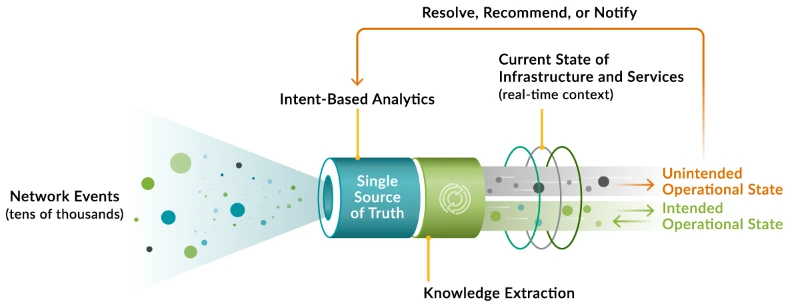
Network Analytics is a complementary component of IBN. With network analytics, the network state is continuously monitored in a closed loop using data collected from the network. This ensures that the intended objective is being maintained on the network and that no deviations occur.

Transition Steps to Intent-Based Data Center Automation
Spine-Leaf Architecture and EVPN-VXLAN
In data center networks, a transition from the classic L2 structure to the L3 structure has occurred over time due to its advantages. Simultaneously, the topological structure also shifted from the Core-Aggregation-Access architecture to the Spine-Leaf architecture in alignment with this transition.

Classic and Spine-Leaf Data Center Network Topologies
Since L2 access is still a significant requirement within the L3 structure, the VXLAN protocol has become widely used to meet this need. The EVPN protocol functions as a complementary protocol to VXLAN in the control plane. Both protocols are fully open standard protocols and can be supported by different vendor devices with the same core features.
While modern data center solutions have become much more efficient through these protocols, the management of these protocols has also become more complex.
With its IBN approach, Apstra simplifies the management of EVPN-VXLAN-based data centers by reducing the complexity of these protocols in the background.
Apstra Core Building Blocks
Apstra is an IBN solution designed for EVPN-VXLAN-based data centers, supporting multiple vendor hardware. Apstra converts simple inputs (intent) received from the network administrator into complex configurations specific to the selected vendor and continuously verifies the accuracy of the intent on the network in a closed-loop manner.
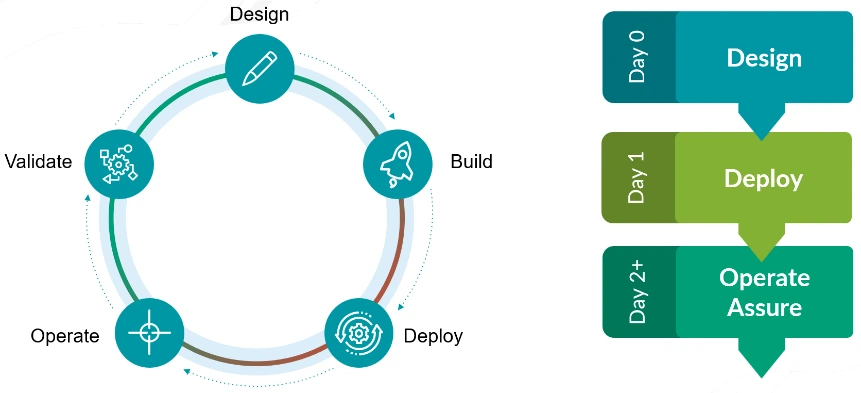
Data Center Operational Phases
Apstra covers all phases in the data center lifecycle, including design, build, implementation, operation, and validation, allowing all these stages to be managed through a single system without the need for an external solution.
On-box Agent
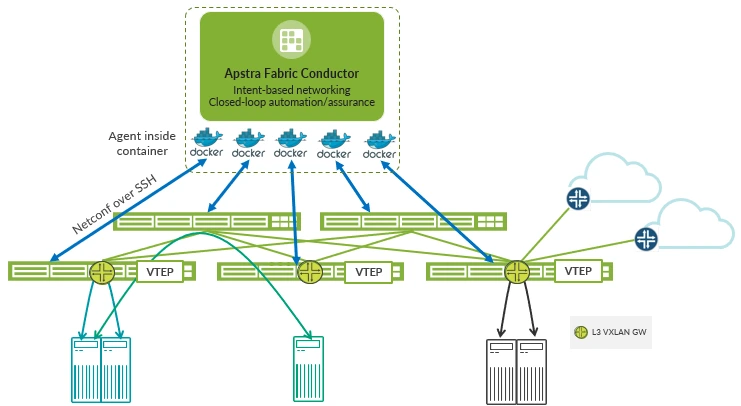
Off-box Agent
Apstra operates as a virtual machine and supports multiple virtualization systems. It manages the network components it controls through on-box or off-box agents.
- On-box agents run directly on the network switch.
- Off-box agents run on Apstra within a container architecture.
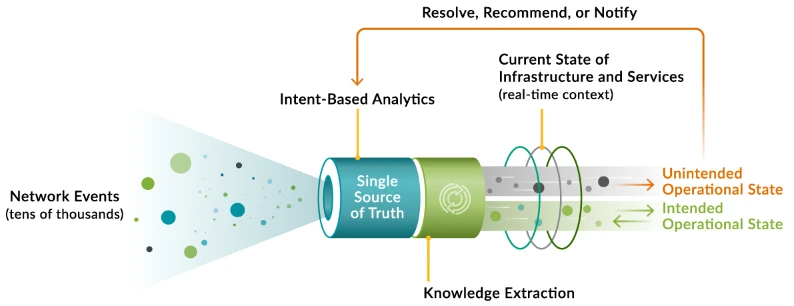
Network Analytics
The network analytics feature is based on telemetry data. Apstra collects telemetry data from network devices to verify the accuracy of the intent.
Additionally, beyond predefined alarms, it allows the creation of simple or complex alarms based on specific telemetry data.
For example, using VM integration, it is possible to create a network analytics probe like:
“Generate an alarm when the packet drop rate on the ports connected to virtual machines containing ‘DB’ in their name exceeds the specified threshold.”
The system automatically identifies the relevant ports based on the probe and processes telemetry data only from those ports.

Graph Database
Apstra uses a non-relational graph database structure. In the graph database, all components in the network are defined as nodes and the connections between these nodes.
The graph database simplifies the analysis of indirect relationships between nodes (such as determining which systems might be affected if a port is shut down).
This database serves as the single source of truth, and any changes in the network are identified based on this single source of truth.
The graph database can be queried to obtain any information related to the network.
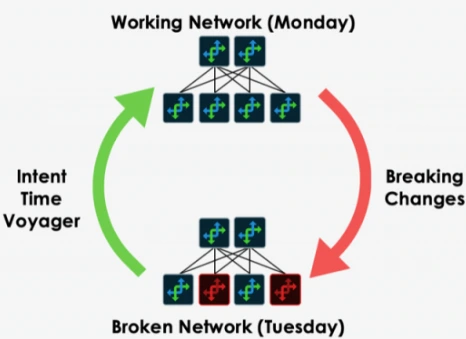
Apstra Time Voyager
Apstra allows for the review of changes made on the network before they are sent to devices. Every change sent to devices is recorded in the system, and it is possible to rollback to any specific change point when needed.
This enables the system to revert to a previously consistent state in case of any issues.
Design and Implementation with Apstra
The design phase involves a series of predefined steps, with the ultimate goal of creating a blueprint. The blueprint is where the implementation and monitoring take place.
- Apstra manages each EVPN-VXLAN-based spine-leaf architecture under a separate blueprint definition. A single Apstra deployment can manage multiple blueprints and data centers.
- A blueprint is generated from a template. The template contains the necessary information regarding spines, leafs, and end systems within the blueprint. One template can serve as a source for multiple blueprints.
- Templates consist of racks, which include leaf(s) and the connected systems. Racks can be used in multiple templates.
- To avoid manual entries, pools for ASN, IP, and VNI are created in the system. If the network administrator does not make a specific selection, assignments are automatically made from these pools.

Blue Print
On the blueprint, it is possible to visually inspect not only the spine-leaf switches but also the connected systems. As data center infrastructure solutions expand, this eliminates the increasing complexity of determining which system is connected to where.
And More
Apstra allows you to easily design, manage, and monitor EVPN-VXLAN-based data centers using the IBN approach. It reduces operational workload and error risk while increasing business continuity by instantly detecting issues.
- Supports multiple vendors, allowing the use of hardware from various manufacturers.
- Simplifies data center lifecycle management, making it more efficient and sustainable.
For more information about data centers, data center solutions, and more, visit our data center expertise page.