Cisco and Red Hat Strengthen Collaboration for Digital Transformation
16 Jan 2024
Prepared by: Alperay Burak Keleş – SD-X & Cloud Technology Engineer
The technology world continues to evolve with new innovations every day. Undoubtedly, in this period, innovations are particularly concentrated on AI (Artificial Intelligence) and cloud computing. Businesses are leveraging AI technologies more than ever to drive transformation in their operations and provide better experiences to their customers.
Thus, in the digital transformation journey, artificial intelligence has become both the most effective solution and one of the biggest challenges for businesses. Different application stacks and infrastructure patterns create new challenges for IT teams trying to support these initiatives.
To overcome these challenges, assist organizations in their digital transformation processes, and improve operations on cloud-based applications, Cisco and Red Hat offer flexible and simple solutions.
The focus of this article is the latest developments and innovations announced at the 28th Cisco Partner Summit, held by Cisco in November 2023.
New Cisco Observability Platform
The Cisco Observability Platform offers significant business value for partners and is built around five critical themes: Business Insights, SAP, Networking, MLOps, and Sustainability modules. This new vendor-agnostic observability ecosystem helps customers address specific observability needs.
Cisco Observability Platform is an open, extensible, API-based platform. It focuses on OpenTelemetry and processes metrics, events, logs, and traces. It provides AI/ML-powered analytics and consolidates data from multiple areas, including applications, networks, infrastructure, security, and cloud. With this solution, organizations can reduce time to resolve issues, optimize experiences, and minimize business risks.
New Cisco Security Bundles
Cybersecurity threats are becoming more prevalent and increasingly complex. The security industry has a long history of developing solutions to address these issues. However, whenever a new security issue arises, a new product is typically launched to address it. While these products are effective, the excessive proliferation of products that do not fully resolve customer problems or meet their needs has led to increased costs and complexity.
The new security bundles, introduced at the 28th Cisco Partner Summit, provide a predictable and cost-effective way to leverage Cisco’s robust security product portfolio. Focused on three critical use cases — User, Cloud, and Breach Protection — the bundles aim to enhance security effectiveness, improve user experience, and increase ROI. The bundles are designed to operate in multi-cloud and hybrid cloud environments and are compatible with other tools and systems.
A New Perspective on Infrastructure and Operations with AI
Artificial intelligence is driving significant changes in data center technologies. For example, network infrastructure must support data warehouse processing to handle model training and configuration. Storage must be effortlessly scalable and closely linked to data processing. Additionally, as AI becomes embedded in every application, data processing must be accelerated efficiently. Thus, all requirements related to data ingestion, preparation, model training, and model configuration necessitate powerful GPUs.
Customers are open to adopting new tools and development frameworks but wish to avoid the complexity that may arise with these new processes. Below are ideal Cisco technologies for customers who want to maintain their existing infrastructure:
- The UCS X-Series modular system allows flexible CPU/GPU ratios and cloud-based management with X-Fabric technology.
- The Cisco AI/ML enterprise network building plan ensures the high performance and efficiency required for AI/ML workloads with Cisco Nexus.
- High-performance storage systems from NetApp and Pure address the requirements of expanding data sets.
Cisco introduces new designs and automation scenarios to seamlessly integrate AI infrastructure across core, cloud, and edge locations. These solutions are based on three primary approaches to reduce complexity and increase efficiency:
- Establishing AI infrastructure as a foundation
- Operationalizing and automating AI deployments and lifecycles with validated designs and automation scenarios
- Ensuring AI infrastructure is secured through proactive, robust automation and comprehensive security while preparing for future technologies
Red Hat OpenShift AI and ML/AI Developments
Red Hat OpenShift AI is a flexible and scalable MLOps platform equipped with tools for building, deploying, and managing AI-powered applications. Built on open-source technologies, it provides reliable and operationally consistent capabilities for teams to create models and conduct experiments.
Red Hat OpenShift AI supports AI/ML models on bare metal and public cloud. It eliminates the dependency on IT for infrastructure requirements that arise from repetitive and computationally intensive ML modeling. With containerized ML tools, ML models can be easily rebuilt and scaled.
The tight integration with CI/CD tools allows for rapid, iterative deployment of ML models as needed. Containers and Kubernetes are key to accelerating life cycles in ML processes, as they provide the much-needed agility, flexibility, portability, and scalability for data scientists to train, test, and deploy ML models.
Red Hat OpenShift, with its hybrid cloud platform for containers and Kubernetes, not only offers all these advantages but also fosters better collaboration between data scientists and software developers through integrated DevOps capabilities (e.g., OpenShift Pipelines, OpenShift GitOps, and Red Hat Quay).
Red Hat has developed a partner ecosystem for various AI/ML use cases in sectors such as healthcare, finance, telecommunications, and automotive. Companies like NVIDIA, IBM Watson Studio, Anaconda, and Intel are part of this ecosystem, offering certified software and solutions compatible with the AI/ML platform.
For instance, Red Hat OpenShift accelerates computationally intensive ML modeling tasks through integration with popular hardware accelerators like NVIDIA GPUs. This integration simplifies the selection of ML models with the highest predictive accuracy, ensuring that ML outcomes improve as new data is generated.
Cisco Validated Design
In today’s rapidly evolving technological landscape, businesses need to stay open to innovations to remain competitive. While this offers significant potential, many innovations may seem risky to organizations, making it difficult for them to fully capitalize on the potential benefits.

Cisco Validated Designs (CVD) provide a reliable roadmap for businesses in a technology landscape that is constantly evolving and demanding new breakthroughs. CVDs are tested and documented approaches that assist in successfully designing, deploying, and scaling new technologies. These guides document the creation of potential network configurations and how to integrate new solutions with existing systems, offering best practices for successful deployments.
CVD solutions cover Cisco’s extensive range of technologies and are integrated and tested with Red Hat platforms, particularly Red Hat OpenShift. This integration ensures effective interoperability between the technologies of both companies. CVD solutions provide a structure that simplifies the deployment and management of Red Hat OpenShift on Cisco infrastructure, enabling faster, more reliable, and entirely predictable deployments.
- Improved Deployment Time: CVDs facilitate the rapid implementation of solutions, from system designs to configuration instructions.
- Reduced Risk: CVDs are based on common use cases and predictable system priorities.
- Predictability: Comprehensive testing allows CVDs to meet performance expectations and deliver faster, more reliable deployments.
Cisco Validated Designs Include Two Types of Guides: Technology Design Guides and Solution Design Guides
- Technology Design Guides provide deployment details, verified product and software information, and best practices for specific technology types.
- Solution Design Guides integrate existing CVDs and provide information about Cisco product features and third-party integrations.
Both guide types offer a tested starting point for Cisco partners or customers to begin designing and deploying their systems.
Each guide includes a navigator that helps users determine its suitability for their needs. The navigator provides information on four main elements: Use Case, Scope, Proficiency, and related CVD Guides. After selecting the appropriate guide, users can choose to implement it fully or partially.
Cisco and Red Hat Collaboration
Cisco and Red Hat have continued their decade-long partnership to bring the value of AI to more businesses. The collaboration focuses on developing solutions optimized for hybrid cloud environments.
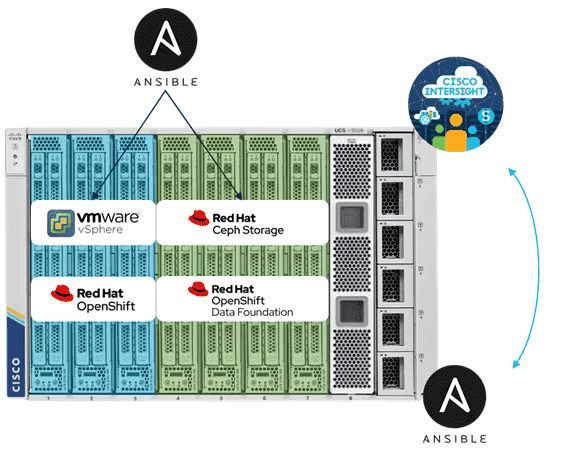
The developed CVDs address specific needs in these environments, such as business continuity, data backup, multi-cloud automation, and application modernization. This design presents the Red Hat OpenShift Container Platform and Red Hat OpenShift Data Foundation on vSphere as Infrastructure as Code (IaC), enabling organizations to manage their infrastructure more efficiently.
Red Hat OpenShift AI facilitates data scientists in rapidly and easily developing, testing, and deploying AI models in hybrid cloud environments.
Cisco UCS X-Series adapts to the unpredictable requirements of modern applications. This platform combines blade and rack servers in a single modular system for improved automation and efficiency.
This modularity allows the system to adapt to and support new technologies as they emerge. Delivered as IaC with Intersight Ansible, the Cisco UCS X-Series eliminates error-prone manual tasks, enabling faster and more consistent solution deployments.
Red Hat OpenShift is a leading Kubernetes platform that provides a consistent experience across cloud, on-premise, and edge environments. With its consistent experience, OpenShift allows organizations to choose where to build, deploy, and run their applications.
Red Hat OpenShift offers developers self-service provisioning and full-stack automated operations, enabling teams to work more efficiently from development to production. Teams can turn their ideas into reality faster.
OpenShift Data Foundation provides a software-defined storage solution optimized for OpenShift. It works seamlessly with OpenShift and can be easily managed through the interface. This storage solution is based on petabyte-scale Ceph cloud storage, Rook Kubernetes storage operator, and NooBaa multi-cloud object gateway technology.
Combining Cisco UCS X-Series with Red Hat OpenShift Container Platform and OpenShift Data Foundation simplifies container infrastructure deployment and management, providing agility to organizations. By enabling infrastructure automation and more efficient use of resources, it reduces operating costs. Additionally, OpenShift is based on open-source technologies, offering more control and flexibility.
In conclusion, the announced innovations demonstrate Cisco and Red Hat’s commitment to shaping the future of digital transformation and helping customers achieve their business objectives together.
Cisco’s Observability Platform and newly introduced security bundles play a critical role in organizations’ digital transformation journeys by providing deeper insights and enhanced security.
Red Hat OpenShift AI enables data scientists and developers to develop, test, and deploy AI/ML models quickly and easily.
The combination of Cisco’s robust infrastructure solutions and Red Hat’s innovative cloud and AI technologies offers organizations faster, more secure, and more predictable digital transformation processes.
The integration of Cisco Validated Designs (CVD) and Red Hat OpenShift enables organizations to manage complex IT needs more simply and effectively, gaining a competitive edge while remaining open to technological innovations.
The Cisco and Red Hat collaboration pushes the boundaries of technology, playing a key role in making digital transformation processes more efficient, secure, and manageable for organizations.
As a Premier Partner of Red Hat and a Gold Partner of Cisco, we are ready to meet your organization’s needs with comprehensive solutions. Contact us now to learn more!
Other Posts
What is BGP? Route Advertisements and the Backbone of the Internet
AI Datacenter Network Architecture | Why the Fastest GPUs Are Not Enough: The Defining Role of Network Infrastructure in AI Workloads
Meet Sekom at MWC2026 Barcelona: Network Intelligence for Real-World Operations
See all posts